1. Does Kansas Require an LLC Annual Report?
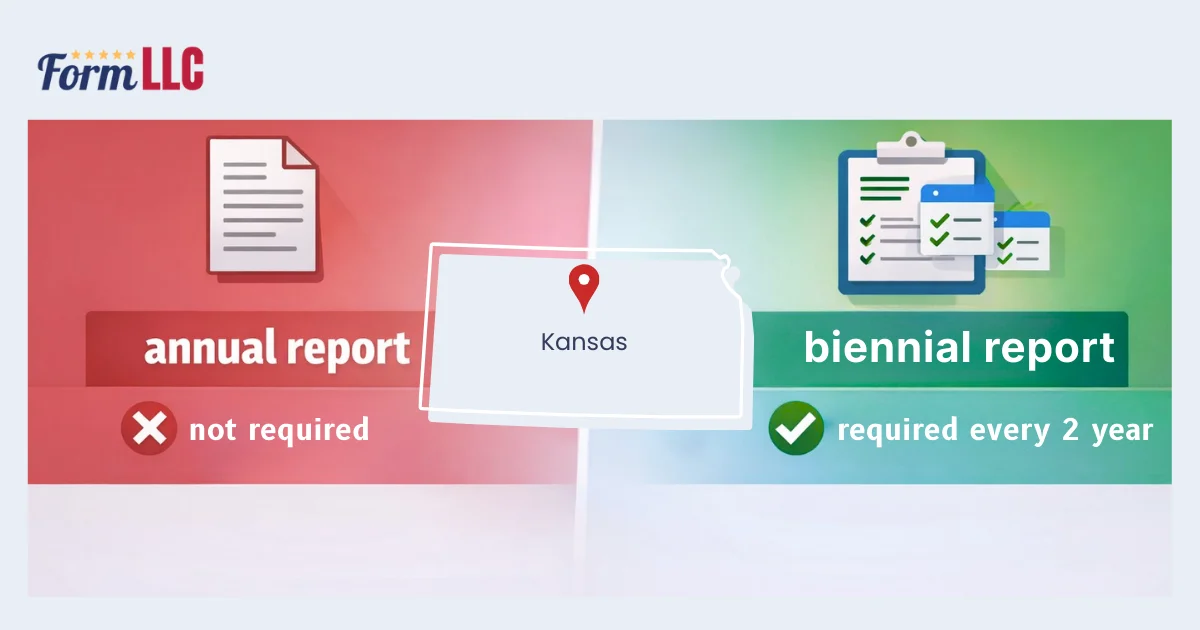
Yes — Kansas requires most businesses (including LLCs) to file an Information Report with the Kansas Secretary of State . But here’s the key detail: it is generally filed every two years (biennially), not every year. That’s why many founders call it an “annual report,” even though Kansas uses a biennial schedule.
2. What Kansas LLCs Must File (Information Report)
Kansas LLC compliance for this topic is straightforward: file the Information Report in your required filing year. The report is used to confirm key company details and keep your record current.
What the Information Report typically includes
- Kansas business ID/file number (this is not your EIN)
- Legal LLC name exactly as on Kansas records
- Principal office address (physical address — avoid PO box for the principal office)
- Reporting year that matches the year the report is due
- Domestic Kansas LLCs: list members owning 5% or more (with addresses)
- Authorized signature
3. Kansas Filing Schedule (Odd/Even Years)
Kansas uses a simple rule for biennial reports published by the Kansas Secretary of State : Businesses formed in even years file in each succeeding even year, and businesses formed in odd years file in each succeeding odd year.
Quick examples
- Formed in 2024 (even year): file in 2026, 2028, 2030...
- Formed in 2025 (odd year): file in 2027, 2029, 2031...
If you only remember one thing: Kansas LLC “annual report” searches usually refer to a biennial Information Report. The year you file depends on your LLC’s formation year (odd/even).
4. Kansas LLC Due Dates (Common Scenarios)
Kansas due dates depend on the type of business, but most standard for-profit businesses follow an April deadline. In general, for-profit entities are due by April 15, while nonprofit entities commonly follow a June deadline.
Common due dates
- For-profit LLCs: commonly due by April 15 of the filing year
- Non-profit entities:June 15 of the filing year
- Filing year:
What can create mistakes?
- Not realizing Kansas is biennial (odd/even)
- Using the wrong reporting year on the form
- Not listing required 5%+ members (for Kansas domestic LLCs)
- Using a PO box as the principal office address
STAY COMPLIANT
Click the button below and our team will guide you through Kansas filings—fast and correctly.
Get Compliance Help5. Where to File + What You’ll Need
Kansas Information Reports are filed with the Kansas Secretary of State. You can usually file online using the Kansas Business Center online filing system . Before you start, keep your key details ready so you can submit without errors.
What you should keep ready
- Kansas business ID/file number
- Legal LLC name exactly as registered
- Principal office address (physical address)
- Reporting year (must match the year the report is due)
- Domestic Kansas LLCs: list of members owning 5%+ and their addresses
Why founders use a compliance service
- Avoid filing in the wrong year (odd/even confusion)
- Reduce rejections due to missing ownership/address information
- Maintain good standing for banks, payment processors, and contracts
| Feature | FormLLC | Provider A | Provider B |
|---|---|---|---|
| Built for non-US founders | ✅ Deep non-resident focus | ➖ Limited support | ➖ Generic templates |
| End-to-end compliance guidance | ✅ State + federal clarity | ➖ Partial | ➖ DIY-heavy |
| Transparent pricing | ✅ No surprise upsells | ⚠️ Hidden add-ons | ⚠️ Tiered upsells |
| Human support (WhatsApp / email) | ✅ Dedicated support | ➖ Ticket-based | ➖ Slow response |
*Sample stats for illustration. Add your real numbers and link to verified reviews.
Kansas compliance is often missed due to the odd/even year rule. File the Information Report in the correct year, keep your Registered Agent active, and store your confirmation. This avoids issues with banks, payment gateways, and vendor verification.
6. How to File Kansas LLC Information Report (Step-by-Step)
Step 1: Confirm your filing year (odd/even schedule)
First, confirm whether your LLC was formed in an odd or even year. That determines which years you must file. Then confirm whether your entity is treated as for-profit (commonly due April 15) or not-for-profit (commonly due June 15).
Step 2: Gather required company details
Have your Kansas business ID/file number, legal name, principal office address, and reporting year ready. If you are a Kansas domestic LLC, also prepare the list of members who own 5% or more (with addresses).
Step 3: File online (recommended) or by mail if needed
Most founders file online through the Kansas Secretary of State Information Report filing portal . Online filing is faster and easier for record-keeping.
Step 4: Pay the filing fee and save proof
After filing, save a compliance copy/receipt in your “Compliance Folder.” This helps with audits, banking, and future compliance checks.
Step 5: Repeat every two years (biennial)
Set a reminder for your next required year (odd/even schedule). Kansas compliance is easy when you treat it like a recurring calendar event.
7. Tips to Stay Compliant
- Set reminders for your odd/even filing year (biennial schedule)
- Use the correct reporting year (must match the year the report is due)
- Store confirmation/receipt in a compliance folder
- Keep Registered Agent service active and details up to date
8. Fees, Delinquency & Forfeiture
- Kansas LLC Information Report fee (online): $100
- Kansas LLC Information Report fee (paper): $110
- Delinquency window: Kansas provides a period after the due date where the report may still be filed
- Forfeiture risk: If delinquency passes without filing, the business can forfeit and may require reinstatement
- Good standing impact: Compliance affects business banking , payment platforms, and vendor onboarding
| Compliance Item | Typical Timing | Fee |
|---|---|---|
| Information Report (Kansas LLC) | Biennially (odd/even year schedule) | $100 online / $110 paper |
| Registered Agent Renewal (if using a service) | Annually | $100–$300 |
| Federal Income Tax Return | Annually | Varies |
| Annual Report (Traditional) | Not the Kansas standard (Kansas uses an Information Report) | N/A |
9. Federal Compliance That Impacts Kansas LLCs
1. Federal tax return (IRS)
Your Kansas LLC’s federal tax filing depends on classification and is governed by the IRS LLC tax rules .
Single-member LLCs often report on the owner’s return, partnerships file an informational return, and S-corp elections follow S-corp filing rules.2. EIN (Employer Identification Number)
Many LLCs use an EIN to open bank accounts, hire employees, and work with payment processors. Keeping EIN confirmation documents helps with compliance documentation.
3. BOI updates (Corporate Transparency)
If your ownership or key information changes, you may need to update federal beneficial ownership information through FinCEN’s BOI reporting system . This is separate from Kansas biennial reporting but often comes up during annual reviews.
4. Other recurring federal obligations
- Payroll tax filings if the LLC has employees
- Information returns (such as 1099 forms) when required
- Clean bookkeeping for audits, banking, and compliance reviews
10. Conclusion
The biggest takeaway: Kansas LLC “annual report” searches typically refer to a biennial Information Report. File it in the correct year (odd/even schedule), pay the fee, and store your confirmation.
With FormLLC, you can stay compliant without confusion—our team helps you follow the right schedule, file the right report, and keep your business in good standing.
11. Frequently Asked Questions
Kansas usually requires a biennial Information Report (every 2 years) for LLCs and other business entities. Many people call it an “annual report,” but Kansas runs on an odd/even year filing schedule.
For most for-profit entities, it’s commonly due by April 15 of the required filing year. Your required year depends on whether the business was formed in an odd year or even year.
For an LLC, Kansas commonly charges $100 online and $110 paper for the Information Report filing.
Kansas provides a delinquency period after the due date. If the report is not filed within the allowed window, the business can forfeit and may need reinstatement to restore good standing.
You typically need your Kansas business ID/file number, legal name, principal office address, reporting year, and for Kansas domestic LLCs: the list of members owning 5% or more (with addresses).