1. What Does It Mean to Dissolve an LLC in New Hampshire?
Dissolving an LLC in New Hampshire is the formal legal process of ending a
limited liability company’s existence after dissolution documents are
accepted by the New Hampshire Secretary of State. Simply stopping operations,
becoming inactive, or abandoning the business does not legally close the LLC.
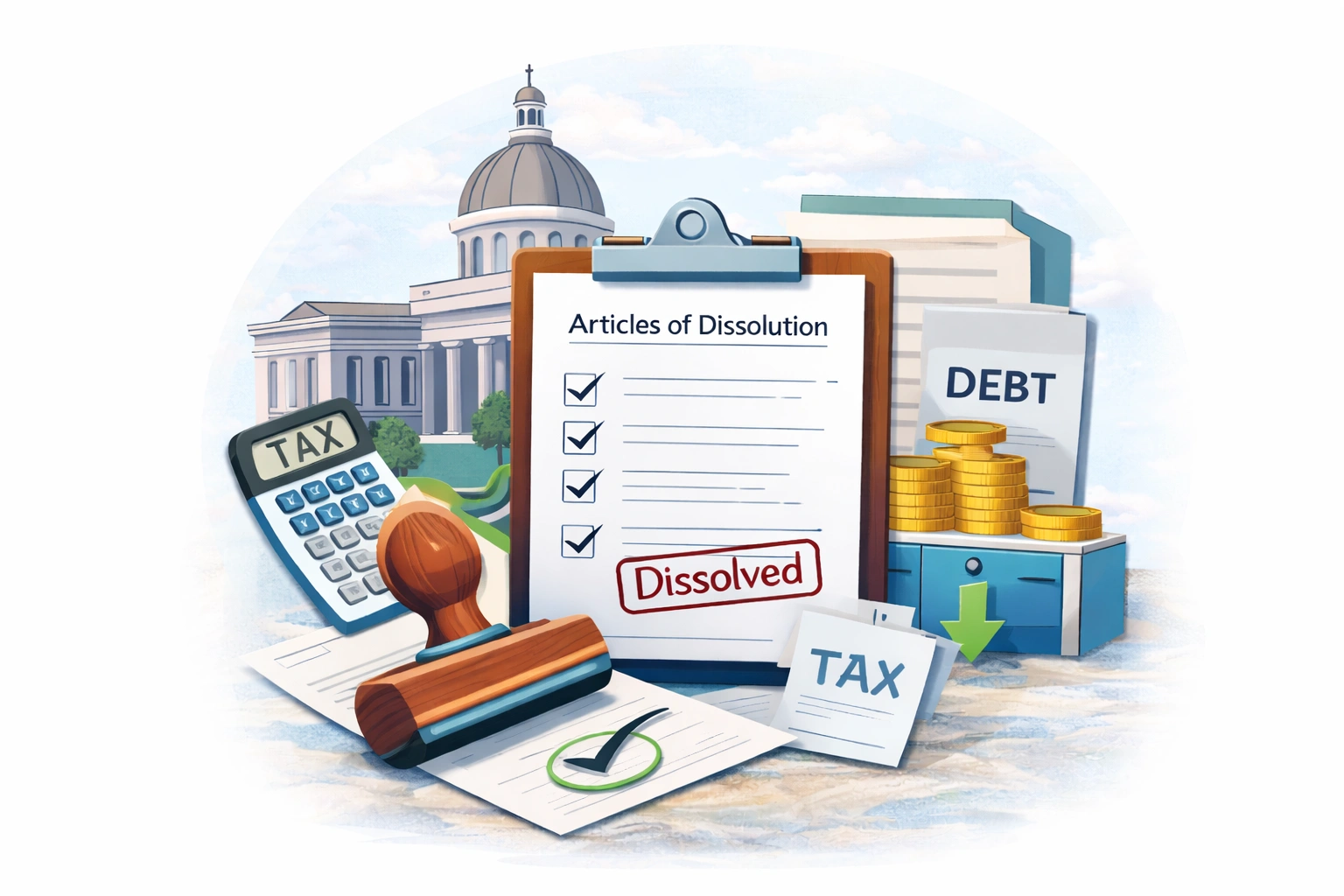
Dissolution generally involves completing wind-up activities, filing Articles
of Dissolution, settling debts, distributing assets under state law or an
operating agreement, and completing final federal and New Hampshire tax
filings to ensure removal from records.
2. When Should You Close or Dissolve a New Hampshire LLC?
You should close or dissolve a New Hampshire LLC when the business has permanently stopped operating, no longer intends to generate revenue, or has fulfilled the purpose for which it was formed. Voluntary dissolution formally ends the LLC’s legal existence with the New Hampshire Secretary of State and prevents the state from continuing to treat the company as an active business entity for administrative, compliance, or legal purposes.
This section focuses on voluntary dissolution, which is initiated by the LLC’s members or managers. Voluntary dissolution differs from administrative dissolution, which occurs when the state dissolves an LLC for statutory noncompliance—such as failing to maintain a registered agent, file required annual information, or respond to official state notices. Choosing voluntary dissolution allows owners to control the timing and process of closure, properly wind down the business, resolve outstanding obligations, and reduce the risk of future notices, penalties, or legal exposure.
Common situations where dissolving a New Hampshire LLC is appropriate
- Business inactivity: the LLC has ceased operations and does not plan to conduct business in New Hampshire or elsewhere
- Member-approved closure: the members have agreed to permanently close the LLC in accordance with the operating agreement or New Hampshire law
- Business restructuring: the LLC is merging, converting to another entity type, or transitioning to a different business structure
- Inability to continue operations: loss of key licenses, contracts, funding, or overall business viability
- Preventive closure: formally dissolving the LLC to avoid ongoing state correspondence, annual filing obligations, unresolved compliance issues, or future administrative complications
3. Things to Do Before Dissolving an LLC in New Hampshire
Before dissolving an LLC in New Hampshire, it is recommended to complete a few practical wind-down steps to ensure the business is closed cleanly and does not leave unresolved legal, tax, or administrative matters behind. While New Hampshire does not require tax clearance, certificates of good standing, or proof of compliance before filing Articles of Dissolution (Domestic LLC), addressing outstanding obligations in advance can help prevent post-dissolution notices, penalties, or follow-up issues.
The steps below are recommended best practices rather than formal filing requirements under New Hampshire law. Completing them before filing dissolution documents helps ensure an orderly closure before the LLC is formally dissolved with the New Hampshire Secretary of State.
Pre-dissolution checklist (recommended best practices)
- Review the operating agreement: confirm any member approval requirements, voting thresholds, or dissolution procedures outlined in the LLC’s operating agreement or, if none exists, those provided under New Hampshire law
- Approve and document the dissolution: obtain formal approval from members and record the decision in written resolutions or meeting minutes for legal, tax, and record-keeping purposes
- Resolve outstanding debts and liabilities: pay or make reasonable provision for obligations owed to creditors, vendors, employees, contractors, and service providers before dissolution
- Wind down business operations: complete or terminate open contracts, notify customers where appropriate, cancel subscriptions, and prepare to close business bank accounts and payment platforms
- Review New Hampshire tax registrations and obligations: determine whether the LLC has any active New Hampshire tax accounts—such as sales tax, employer withholding, or unemployment insurance—and ensure required filings and payments are completed or closed
- Review federal tax filing requirements: confirm all required federal filings associated with the LLC’s EIN are up to date and determine whether any final federal income, employment, partnership, or information returns are required based on the LLC’s federal tax classification
- Assess federal BOI reporting obligations (if applicable): determine whether a final Beneficial Ownership Information (BOI) update is required due to ownership or control changes. BOI reporting is a federal requirement and applies independently of New Hampshire dissolution filings
- Prepare and retain final records: organize financial records, tax filings, member approvals, and dissolution-related documents for future reference, verification, or audit purposes
These steps are recommended best practices and are not required by New Hampshire before filing Articles of Dissolution (Domestic LLC). New Hampshire requires only the filing of Articles of Dissolution to legally close a domestic LLC, but completing these steps helps reduce the risk of post-dissolution tax, legal, or administrative issues.
4. Step-by-Step: How to Close or Dissolve an LLC in New Hampshire
Closing or dissolving an LLC in New Hampshire is the legal process of formally ending the company’s existence with the New Hampshire Secretary of State. Simply stopping operations or allowing the LLC to remain inactive does not legally close the business. An LLC remains active in New Hampshire records until Articles of Dissolution (Domestic LLC) are filed and accepted by the state.
Key point: New Hampshire requires only one state filing to dissolve a domestic LLC—Articles of Dissolution. While New Hampshire does not require tax clearance, certificates of good standing, or proof of paid taxes before dissolution, completing recommended wind-down steps helps reduce the risk of post-dissolution notices or follow-up issues.
- Approve the dissolution (legally required): obtain member approval as required by the LLC’s operating agreement or, if none exists, under New Hampshire law. Document the approval in written resolutions or meeting records.
- Complete wind-down activities (recommended): settle outstanding debts and liabilities, complete or terminate contracts, notify creditors or customers where appropriate, and formally cease business operations.
- Review New Hampshire tax registrations (recommended): determine whether the LLC has active New Hampshire tax accounts—such as sales tax, employer withholding, or unemployment insurance—and complete required filings or close accounts as applicable.
- Review federal tax and reporting obligations (recommended): confirm all required federal filings associated with the LLC’s EIN are complete and determine whether any final income, employment, partnership, or information returns are required.
- Prepare the Articles of Dissolution (legally required): complete the Articles of Dissolution (Domestic LLC), the official form used to terminate the LLC’s legal existence under New Hampshire law.
- File the Articles of Dissolution (legally required): submit the form online or by mail with the New Hampshire Secretary of State. The filing fee is $30 for online submissions and $50 for paper filings. Online filings are typically processed the same day or within one business day.
- Confirm dissolution status (recommended): retain proof of filing and verify that the LLC’s status shows “Dissolved” in New Hampshire business records, confirming the company is no longer active.
READY TO CLOSE YOUR NEW HAMPSHIRE LLC?
Get clear guidance on required forms, filing fees, and the correct process to close or dissolve your New Hampshire LLC without future penalties or compliance issues.
Close My New Hampshire LLC5. DIY vs Professional LLC Dissolution Services
New Hampshire LLC owners may dissolve their business either on their own or with professional assistance. New Hampshire’s dissolution process is relatively straightforward, and many single-member or inactive LLCs with no outstanding debts or unresolved obligations can complete the process without outside help by filing Articles of Dissolution (Domestic LLC) with the New Hampshire Secretary of State.
Professional dissolution support is optional under New Hampshire law and is not required to legally close an LLC. Whether assistance is helpful depends on the LLC’s ownership structure, prior administrative issues, outstanding obligations, and the owner’s comfort handling legal and administrative filings.
What typically increases the complexity of dissolving a New Hampshire LLC?
- Multiple members or unclear voting, approval, or dissolution provisions in the operating agreement
- Outstanding debts, contracts, lawsuits, or unresolved creditor claims
- Prior administrative dissolution, unresolved state or federal tax accounts, or incomplete wind-down activities
When professional dissolution support may be helpful
- Reducing the risk of missed steps, improper filing order, or incomplete wind-down activities
- Assistance with New Hampshire-specific filings, including Articles of Dissolution (Domestic LLC), and review of final obligations
- Added confidence that the LLC is properly dissolved and no longer subject to ongoing administrative notices or future filing complications
Dissolving a New Hampshire LLC involves more than submitting one form. Common issues include unresolved tax accounts, incomplete wind-down activities, prior administrative dissolution, and missing member approvals, which may prompt notices.
6. Filing Fees, Processing Time, and Approval Timeline
Understanding filing fees and processing timelines helps set clear expectations when closing or dissolving an LLC in New Hampshire. The state’s dissolution process is generally straightforward, and approval timing primarily depends on whether the filing is complete and whether the Articles of Dissolution are submitted online or by mail to the New Hampshire Secretary of State.
New Hampshire LLC dissolution filing fee
To dissolve a domestic LLC in New Hampshire, owners must file Articles of Dissolution (Domestic LLC) with the New Hampshire Secretary of State. The current state filing fee is $30 for online filings and $50 for paper filings. New Hampshire does not require tax clearance, certificates of good standing, or approval from the New Hampshire Department of Revenue before dissolution documents can be filed.
Processing time
Online Articles of Dissolution filings are typically processed quickly—often within one business day when the submission is complete and accurate. Paper filings generally take longer due to mailing time and manual state processing. Because standard processing is already efficient, New Hampshire does not typically offer expedited dissolution services.
When dissolution becomes legally effective
A New Hampshire LLC is officially dissolved once the New Hampshire Secretary of State accepts and records the Articles of Dissolution (Domestic LLC). At that point, the LLC’s status in state records changes to “Dissolved”, and the company is no longer considered an active New Hampshire business entity.
After approval: what to keep and verify
After dissolution is approved, retain copies of the filed Articles of Dissolution and the state’s acceptance confirmation. These records may be needed later for tax filings, banking closures, contract terminations, audits, or legal verification.
If you prefer assistance with document preparation, filing coordination, or review of final obligations, FormLLC can help ensure your New Hampshire LLC dissolution is completed accurately and without unnecessary delays or follow-up issues.
7. Final Tax Filings and Compliance Related to Dissolution
Although New Hampshire does not require tax clearance or prior approval from the state before an LLC can be dissolved, owners should complete any applicable final tax filings and properly close related tax accounts. Taking these steps helps reduce the risk of future notices, penalties, or enforcement actions after the LLC has been formally dissolved.
New Hampshire state-level tax and closure steps
- Review active New Hampshire tax registrations: determine whether the LLC has any open tax accounts with the state, such as Business Profits Tax (BPT), Business Enterprise Tax (BET), Meals and Rooms Tax (if applicable), employer withholding, or unemployment insurance, and confirm whether filings or payments are required through the date business activities ended.
- Resolve outstanding New Hampshire tax obligations: identify and pay any unpaid state taxes—such as BPT, BET, Meals and Rooms Tax, employer withholding, or unemployment insurance contributions—along with any applicable penalties or interest.
- File final New Hampshire tax returns (if applicable): submit any required final state tax returns with the New Hampshire Department of Revenue Administration and clearly mark them as final where appropriate. While tax clearance is not required for dissolution, state tax accounts should still be properly closed.
- Close New Hampshire tax accounts: formally close or update any active state tax registrations—such as BPT, BET, Meals and Rooms Tax, or employer withholding accounts—to prevent future filing or reporting obligations.
- Cancel state and local licenses or permits: terminate any New Hampshire state or local business licenses, permits, or registrations associated with the LLC to avoid renewal notices, assessments, or unnecessary fees.
Federal tax and record-keeping considerations
- Complete final federal tax filings: file all required federal returns associated with the LLC’s EIN, including final income, partnership, S corporation, or employment tax filings, depending on the LLC’s federal tax classification.
- Retain dissolution and tax records: keep copies of final tax filings, confirmation of account closures, and the filed Articles of Dissolution (Domestic LLC) for future reference, verification, audits, or compliance inquiries.
8. What Happens If You Don’t Properly Dissolve an LLC in New Hampshire?
Simply stopping business operations does not legally close an LLC in New Hampshire. Until Articles of Dissolution (Domestic LLC) are filed with and accepted by the New Hampshire Secretary of State, the LLC continues to exist as a legal entity in New Hampshire’s business records—even if the company is inactive or no longer operating.
Failing to complete a voluntary dissolution can expose owners to ongoing legal, financial, and administrative risk. This is different from administrative dissolution, which occurs when the state dissolves an LLC for statutory noncompliance (such as failing to maintain a registered agent or meet ongoing state requirements). Administrative dissolution is a state enforcement action and does not properly close the business or eliminate existing debts, contracts, or tax obligations.
Common consequences of not properly dissolving a New Hampshire LLC
- Continued legal existence: Without filed Articles of Dissolution, the LLC remains listed as active in New Hampshire Secretary of State records.
- Ongoing compliance obligations: The LLC may continue to be subject to New Hampshire annual list filings and state business license renewal requirements until it is formally dissolved.
- Ongoing state correspondence: Inactive LLCs may still receive administrative notices or compliance communications from the state.
- Unresolved liabilities: Administrative dissolution does not eliminate responsibility for unpaid debts, contracts, or state and federal tax obligations.
- Member and financial exposure: Incomplete wind-down activities or unresolved claims can create ongoing legal or financial risk for LLC members.
- Future filing complications: Improperly closed LLCs may face delays or added requirements when reinstating, dissolving at a later date, or forming new businesses in New Hampshire.
| Issue | When It Occurs | Why It Matters |
|---|---|---|
| LLC not formally dissolved | After business operations stop | The LLC remains active in New Hampshire Secretary of State records |
| Administrative dissolution | After statutory noncompliance | Does not close the LLC or eliminate debts or tax obligations |
| Annual list and license obligations continue | While LLC remains active | May trigger ongoing compliance notices or renewal requirements |
| Unresolved tax accounts | After operations cease | May result in notices, penalties, or enforcement actions |
| Future filing issues | When reinstating or forming a new LLC | Past compliance or closure issues may need resolution first |
9. Closing a Foreign LLC Registered in New Hampshire
What is a foreign LLC?
A foreign LLC is a limited liability company that was formed in another U.S. state or jurisdiction but is registered to conduct business in New Hampshire. If a foreign LLC no longer conducts business or has permanently ceased operations in New Hampshire, it must formally withdraw its registration with the state to end its legal authority to transact business in New Hampshire.
Withdrawal vs. dissolution
New Hampshire does not recognize a “foreign LLC dissolution.” Instead, a foreign LLC must file for withdrawal to terminate its authority to conduct business in the state. Withdrawal does not dissolve the LLC in its home state—it only ends the company’s legal presence in New Hampshire.
To withdraw, the LLC must file an Application for Withdrawal (Foreign LLC) with the New Hampshire Secretary of State. Any dissolution or permanent closure of the LLC itself must be completed separately under the laws of the state or jurisdiction where the LLC was originally formed.
Common requirements to withdraw a foreign LLC from New Hampshire
- File an Application for Withdrawal (Foreign LLC) with the New Hampshire Secretary of State
- Pay the applicable New Hampshire state filing fee for foreign LLC withdrawal (fee set by the Secretary of State at the time of filing)
- Resolve any outstanding New Hampshire tax obligations, such as Business Profits Tax (BPT), Business Enterprise Tax (BET), Meals and Rooms Tax (if applicable), employer withholding, or unemployment insurance, through the New Hampshire Department of Revenue Administration, if applicable
- Confirm the LLC’s status in its home state remains active, withdrawn, or properly dissolved, as required by that jurisdiction
After withdrawal is approved
- The foreign LLC is no longer authorized to conduct business in New Hampshire
- Registration with the New Hampshire Secretary of State ends, and the LLC is removed from New Hampshire’s active business records
- Proof of withdrawal should be retained for tax records, banking matters, audits, and future business registrations
10. Conclusion
Closing or dissolving an LLC in New Hampshire is a formal legal action that permanently ends the business’s existence under state law. Simply stopping operations is not enough—an LLC remains active in New Hampshire records until Articles of Dissolution (Domestic LLC) are filed with and accepted by the New Hampshire Secretary of State.
By completing recommended wind-down steps, addressing any remaining tax obligations, and filing Articles of Dissolution, LLC owners can close their businesses with confidence and reduce the risk of future notices or follow-up issues. New Hampshire’s low filing fees and typically fast processing make voluntary dissolution straightforward when handled correctly. If you prefer guided assistance, FormLLC can help ensure your New Hampshire LLC is dissolved accurately and without unnecessary delays.
11. Frequently Asked Questions
You should dissolve a New Hampshire LLC when the business has permanently stopped operating, is no longer conducting activities, or the members have decided to close the company. Formal dissolution ensures the LLC is officially removed from New Hampshire records and helps prevent future notices, fees, or follow-up issues.
Yes. A New Hampshire LLC continues to exist as a legal entity until Articles of Dissolution (Domestic LLC) are filed with and accepted by the New Hampshire Secretary of State. Simply stopping business operations does not legally close the LLC.
To dissolve a domestic New Hampshire LLC, you must file Articles of Dissolution (Domestic LLC) with the New Hampshire Secretary of State. No additional dissolution forms are required by the state.
Yes. New Hampshire charges $30 for online filings and $50 for paper filings when submitting Articles of Dissolution.
New Hampshire does not require tax clearance before dissolution. However, LLCs should file any applicable final federal tax returns and properly close any active New Hampshire tax accounts with the New Hampshire Department of Revenue, if applicable.
If an LLC is not properly dissolved, it may remain active in New Hampshire records or be administratively dissolved. Administrative dissolution does not close the business or eliminate debts, contracts, or tax obligations.
New Hampshire does not require a traditional annual report for LLCs. However, an LLC must file an Annual List of Managers or Members and renew the state business license each year until the LLC is formally dissolved.
Yes. FormLLC can assist with preparing and filing Articles of Dissolution, reviewing final obligations, and completing recommended wind-down steps to help ensure your New Hampshire LLC is closed correctly.