1. What is US Tax Filing for a Business?
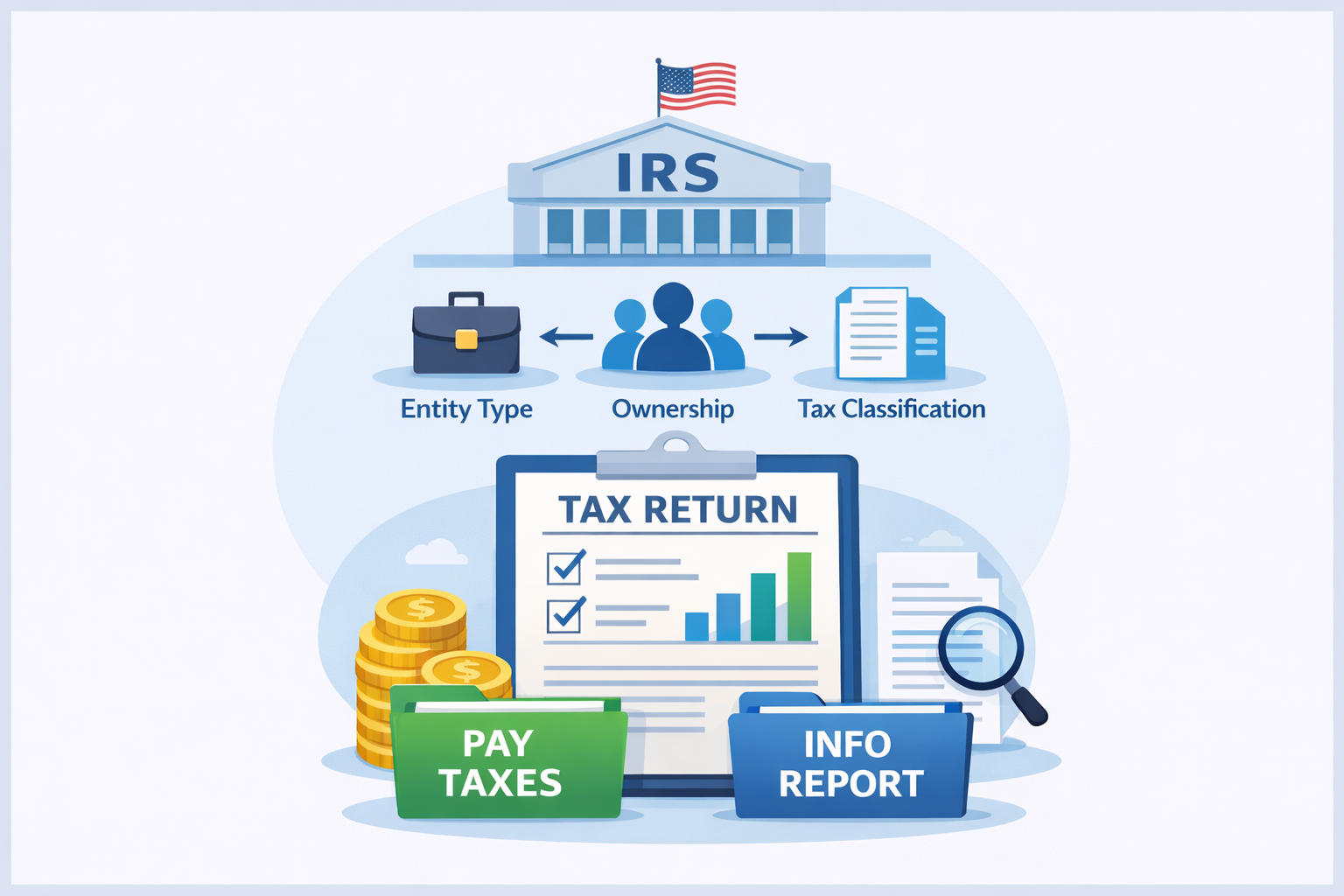
US business tax filing is the process of reporting your company’s financial activity to
the
IRS for a tax year—based on your entity type,
ownership,
and how the business is classified for tax purposes. Even if your company is owned by
non-US residents and operated remotely, US filings may still be required depending on
your
structure and transactions.
In simple terms: your tax return is the IRS “report card” for your company. It can be
an informational filing (reporting only) or a tax-paying filing (owing tax).
2. Who Must File: Non-US Founder Checklist
Non-US founders often assume “no US customers = no filing.” That’s not always correct. Filing depends on the company structure and the type of activity (including reportable transactions).
Quick checklist (common scenarios)
- Foreign-owned single-member LLC: may have reporting (commonly Form 5472 + pro-forma 1120) depending on reportable transactions
- Multi-member LLC (partnership): typically files Form 1065 and issues K-1s
- US C-Corp: generally files Form 1120
- Employees / payroll: may add payroll filings
- US bank account activity: bookkeeping and records still matter for correct reporting
3. Your Entity Type Decides Your Forms
The IRS doesn’t file “one tax return for everyone.” Your required return depends on how your business is structured and classified for tax. The same “LLC” can have different filings based on whether it is single-member or multi-member, and whether it is taxed as a corporation.
Key idea
- LLC (single-member): commonly treated as “disregarded entity” unless elected otherwise
- LLC (multi-member): commonly treated as partnership unless elected otherwise
- C-Corp: separate tax-paying entity (Form 1120)
- S-Corp: election-based and has its own filing pattern
- Owners’ personal returns: may be separate from the business return
The fastest way to avoid mistakes is to confirm your entity type, ownership, and filing category before you start collecting documents.
4. What Documents You Need to Prepare
Most tax delays happen because documents are incomplete. Before filing, prepare a clean package so your accountant (or filing team) can finish quickly and correctly.
- Bank statements: for all business accounts (full year)
- Bookkeeping summary: income, expenses, profit/loss (even if simple)
- Invoices/receipts: especially for major expenses
- Owner/partner details: names, addresses, ownership %, tax IDs if available
- IRS letters: EIN confirmation (CP 575/147C) if available
READY TO FILE?
Click the button below and our team will guide you from document collection to completed filing.
Start Tax Filing Now5. DIY vs Accountant vs Managed Filing
Non-US founders usually choose one of three approaches: do it themselves, hire an accountant, or use a managed process. The right choice depends on complexity, time, and risk tolerance.
What typically changes your complexity?
- Multiple LLCs or multiple partners
- US-source income / withholding / treaty-related details
- High bank activity and many transactions
Why founders choose managed filing
- Fewer missed items and fewer back-and-forth messages
- Clear checklist + timeline
- More confidence that forms match the entity type
| Feature | FormLLC | Provider A | Provider B |
|---|---|---|---|
| Built for non-US founders | ✅ Deep non-resident focus | ➖ Limited support | ➖ Generic templates |
| End-to-end guidance (LLC → EIN → BOI → Tax) | ✅ Included / add-ons | ➖ Partial | ➖ Formation only |
| Transparent pricing | ✅ No surprise upsells | ⚠️ Hidden add-ons | ⚠️ Tiered upsells |
| Human support (WhatsApp / email) | ✅ Dedicated support | ➖ Ticket-based | ➖ Slow response |
*Sample stats for illustration. Add your real numbers and link to verified reviews.
Tax filing is not just “submitting a form.” The real risk is wrong entity classification, missing forms, missing partner details, and late filings. A clean checklist and correct form selection saves time and avoids notices.
6. Step-by-Step: How to File US Taxes
Step 1: Confirm your entity type and filing category
Start by confirming whether your entity is a single-member LLC, multi-member LLC, or C-Corp. This decides the primary return (and whether additional forms are needed).
Step 2: Gather documents and build a clean bookkeeping summary
Collect full-year bank statements and create a simple profit/loss summary. Even if your business is small, a clear summary prevents errors and speeds up preparation.
Step 3: Identify reportable transactions and owner/partner details
Non-US founder filings often require correct owner/partner information and certain related-party details. Keep ownership percentages accurate and consistent across documents.
Common filing windows: March 15 (many partnerships) and April 15 (many corporations/individuals)
Step 4: Prepare the tax return package
Your preparer will typically draft the return(s), confirm numbers, and request clarification for missing items. Respond quickly to avoid delays.
Step 5: Submit and store proof of filing
After submission, keep a “tax archive” folder with a PDF copy of filed returns, confirmation receipts, and your supporting documents.
Step 6: Plan next year early
The easiest tax season is the one you prepare for monthly. Maintain clean records and keep your documents organized as you grow.
Helpful IRS reference:
If you want a guided process, FormLLC can help you collect documents and confirm your filing structure before preparation starts.
7. Tips to Avoid Notices & Penalties
- Keep ownership % accurate across all documents
- Separate personal and business transactions as much as possible
- Respond fast to clarifications during preparation
- File on time or request an extension early
- Store proof of filing + supporting documents in one folder
8. Costs, Penalties & Typical Timelines
- Filing prep cost: Varies by entity, transaction volume, and complexity
- Bookkeeping cleanup: Optional but highly recommended if records are messy
- Late filing risk: Penalties may apply depending on the form and situation
- Timeline: Faster when documents are complete and organized
- Extensions: Often available if requested on time
| Task | Typical Timing | Notes |
|---|---|---|
| Document collection | Start early (Jan–Feb) | Bank statements + bookkeeping summary |
| Partnership return (Form 1065) | Often due March 15 | Issues Schedule K-1 to partners |
| Corporate return (Form 1120) | Often due April 15 | For many calendar-year C-Corps |
| Extension filing | Before the due date | Gives more time (requirements vary) |
| Final review & archive | After submission | Save filed PDFs + proof + support docs |
| Next-year planning | Monthly | Keep records clean to reduce cost |
9. Common IRS Forms (LLC/C-Corp)
1. EIN (Employer Identification Number)
An Employer Identification Number (EIN) is issued by the Internal Revenue Service (IRS) and is used to identify your business for tax reporting. You’ll typically need it for filing, banking, and compliance.
2. LLC Partnership Return (Form 1065)
Multi-member LLCs commonly file an informational return using Form 1065 , and issue Schedule K-1 to each partner.
3. Corporate Return (Form 1120)
US C-Corps generally file Form 1120 . Corporations have their own tax rules and deadlines.
4. Foreign-Owned Single-Member LLC Reporting (Common Pattern)
- Form 5472: Used for reporting certain transactions involving a foreign owner and the US entity.
- Pro-forma Form 1120: Often paired with Form 5472 in some situations to transmit the filing.
- Important: The correct requirement depends on your facts (ownership, activity, and reportable transactions).
5. Owner Individual Filing (when applicable)
- Some owners may need an individual return such as Form 1040-NR depending on income type and tax situation
- Partners typically receive a K-1 from the partnership return
- ITIN may be needed for certain individual filings and treaty claims
10. Conclusion
US tax filing doesn’t have to be confusing. The key is to confirm your entity type, prepare a clean document pack, and file on time (or extend properly).
With FormLLC, you can follow a clear, founder-friendly checklist and complete your filing with less stress and fewer mistakes.
11. Frequently Asked Questions
Often yes. Some structures have reporting requirements even with no US income. A common example is foreign-owned LLC reporting where certain forms may be required depending on reportable transactions and the specific facts.
Partnership returns (Form 1065) are commonly due March 15 for calendar-year entities. If you need more time, you can usually request an extension before the due date.
C-Corp returns (Form 1120) are commonly due April 15 for calendar-year corporations. Extensions are generally available if requested on time.
Not always. Some business returns can be filed without an ITIN depending on the entity type and situation. However, owners may need an ITIN for certain individual filings or when claiming treaty benefits where applicable.
Common documents include bank statements, a bookkeeping summary (income/expenses), invoices/receipts for major expenses, ownership/partner details, and prior-year filings if available.
Missing or incorrect filings can trigger notices and penalties depending on the form and facts. If you’re late, it’s usually better to file as soon as possible and keep your documentation organized.
Yes. FormLLC can guide document collection, confirm your filing type, and coordinate the preparation and submission process for common structures used by non-US founders.